Accretion · Comptonization · Shocks · Timing
TACO is a compact research archive for my numerical and spectral modelling work on accretion flows around compact objects, with emphasis on X-ray binaries, two-component advective flows, neutron-star boundary layers, shocks, Comptonization, and timing signatures.
Overview
The TACO work is organized here into three connected modules. TACO-MC follows photon propagation and thermal Comptonization in the neutron-star TCAF geometry. TACO-HD follows the hydrodynamic formation and oscillation of shocked, cooling flows around weakly magnetized neutron stars. TACO-RT collects the faster spectral-model side of the same framework, including the TCAF Around Neutron Stars / TANS formulation.
Radiative transfer / Monte Carlo
TACO-MC
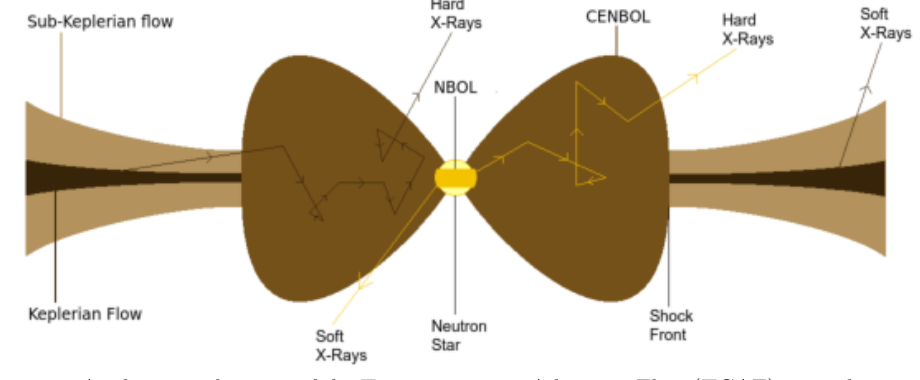
TACO-MC is the Monte Carlo radiative-transfer module developed to study thermal Comptonization in a two-component advective flow around a neutron star. In this setup, soft photons from the Keplerian disc and the Normal Boundary Layer (NBOL) are injected into the hot post-shock region, the CENtrifugal pressure supported BOundary Layer (CENBOL), where they undergo repeated scattering before escaping as the emergent spectrum.
The module was used to examine how the neutron-star boundary layer, the post-shock electron cloud, the disc/halo accretion rates, and the shock location shape the resulting X-ray spectra.
Hydrodynamics / SPH
TACO-HD
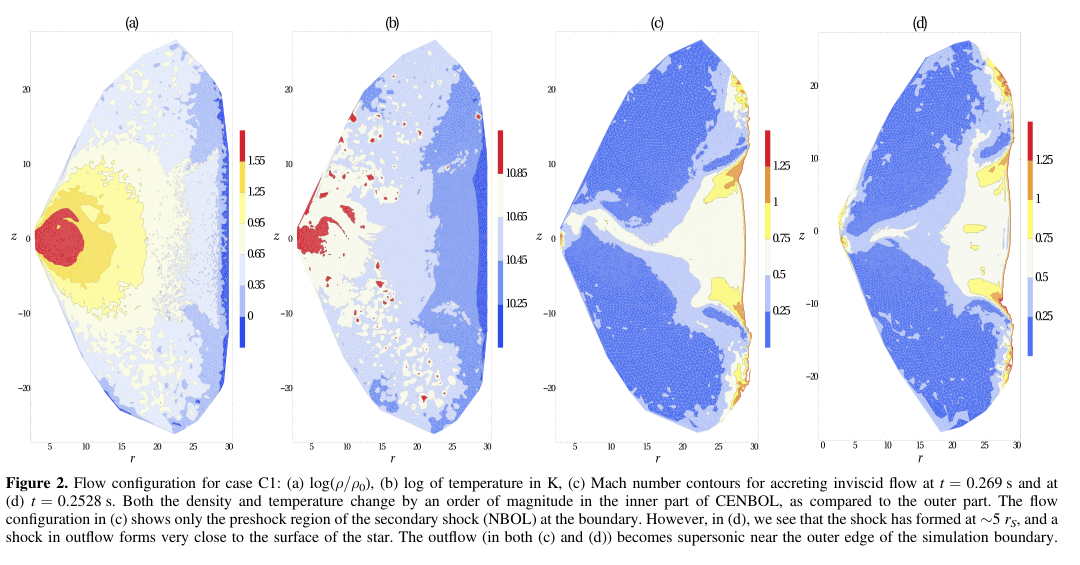
TACO-HD is the hydrodynamic module for studying shocked accretion flows around weakly magnetized neutron stars. The simulations follow low-viscosity, sub-Keplerian inflow using smoothed particle hydrodynamics, with cooling included, in order to study the formation and oscillation of boundary layers and shock fronts.
The work focuses on the dynamical origin of timing features: the formation of CENBOL and NBOL, the emergence of standing or oscillating shocks, the generation of strong outflows, and the connection between shock oscillations and low- and high-frequency QPO-like behaviour.
Spectral model / TANS
TACO-RT
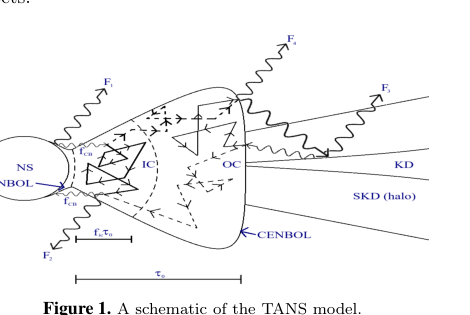
TACO-RT is the spectral/radiative-transfer extension of the TCAF-based neutron-star framework. It uses the physical geometry motivated by the Monte Carlo and hydrodynamic studies, but compresses the calculation into a faster spectral model for accreting neutron stars.
The model combines contributions from the NBOL, the inner and outer Comptonizing regions of CENBOL, and the Keplerian disc. It was designed to explore how Z-source and Atoll-source spectral states can arise from changes in accretion rates, shock location, boundary-layer temperature, cloud transparency, and photon interception between the NBOL and CENBOL.
Resources
The links below collect the main papers and thesis material presently hosted on this page. The labels are meant as a guide to where each item fits within the TACO archive, not as a replacement for the formal publication record.
| Module | Resource | Notes |
|---|---|---|
| TACO-MC | Monte Carlo simulations of thermal Comptonization process in a two-component advective flow around a neutron star | Monte Carlo Comptonization in the neutron-star TCAF geometry. |
| TACO-HD | Timing Properties of Shocked Accretion Flows around Neutron Stars in the Presence of Cooling | SPH simulations of shocked cooling flows, winds, and QPO-like timing behaviour. |
| TACO-RT | A unified spectral model for accreting neutron stars | TCAF Around Neutron Stars / TANS spectral-model formulation. |
| Thesis | Spectral and Timing Properties of Black Holes and Neutron Stars in X-ray Binaries Using Two-Component Advective Flow Solution | Detailed background, schematics, methods, and context across the PhD work. |