Research archive
X-Ray Spectral & Timing Studies
A compact archive of my work on X-ray binaries: spectral fitting, timing analysis, QPO diagnostics, and the use of TCAF/POS-type physical models to connect observed photons to accretion-flow geometry.
Data, software & calibration
Most of the RXTE-based work used public archival data accessed through HEASARC, reduced with HEASOFT/FTOOLS, and analysed with XSPEC and XRONOS-style timing tools. AstroSat/LAXPC work used LAXPC event data and LaxpcSoft.
Black-hole transients
H1743-322: outburst evolution with TCAF + POS
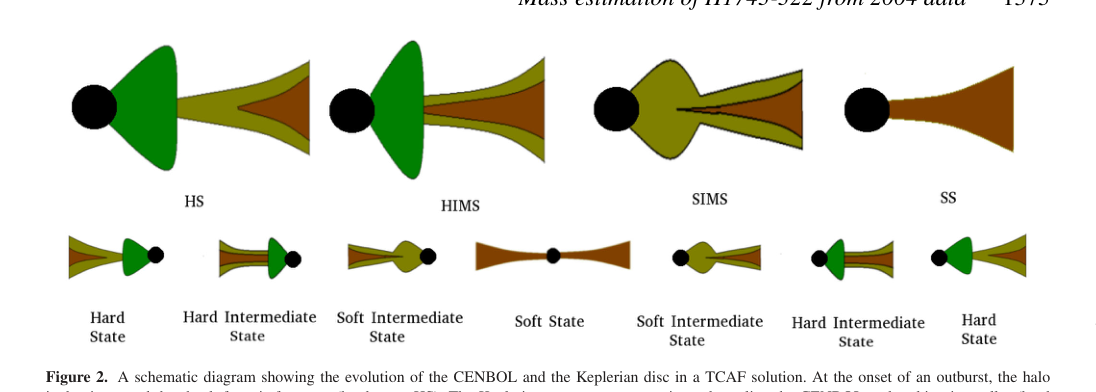
The H1743-322 study used RXTE/PCA data from the 2004 outburst to track the day-to-day evolution of physical flow parameters: Keplerian disk rate, sub-Keplerian halo rate, shock location, compression ratio, and the size/location of the Comptonizing region. The timing side used the presence and evolution of QPOs, interpreted through the propagating oscillatory shock picture, to connect spectral evolution with shock motion.
The result is a compact example of the central aim of this part of my work: use spectral and temporal information together, rather than treating them as disconnected diagnostics.
Persistent black-hole systems
Cygnus X-1: hard-state flow parameters and mass constraint
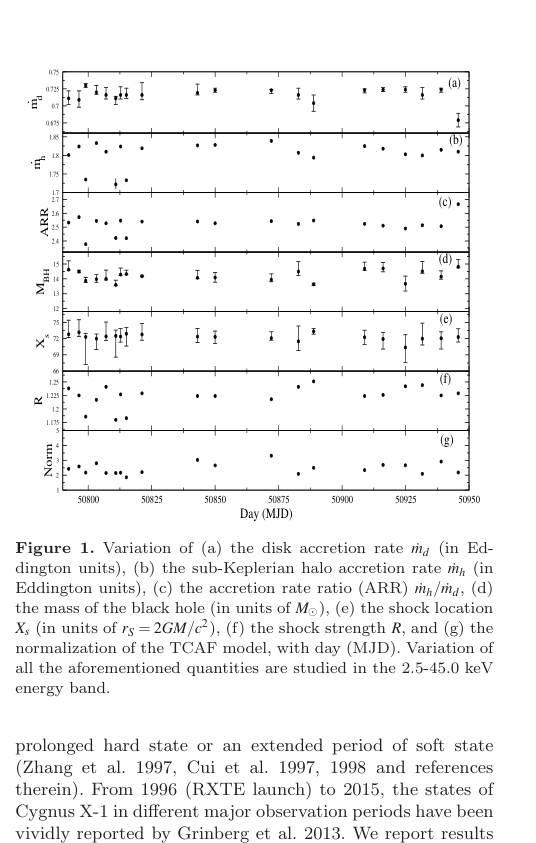
The Cygnus X-1 work focused on a stable hard-state interval in RXTE/PCA data. Spectra in the 2.5–45 keV range were fitted with a TCAF-based model plus a Gaussian line component, allowing the disk rate, halo rate, shock location, shock strength, normalization, and black-hole mass to be extracted from individual spectra.
The narrow variation of the fitted flow parameters is the important physical point: the source behaves like a persistent hard-state system with a relatively stable Comptonizing region. Averaging the fitted masses provided an independent mass estimate consistent with dynamical constraints.
Class-variable microquasars
GRS 1915+105 and IGR J17091-3624
χ class: steady classes, outflow signatures
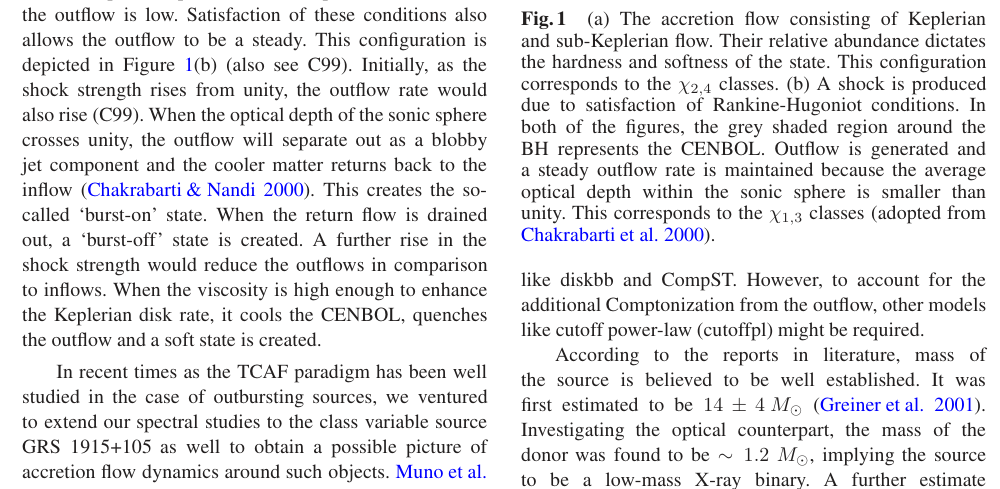
The χ-class study separated the radio-quiet χ₂/χ₄ classes from the radio-loud χ₁/χ₃ classes. The former were fitted with TCAF alone, while the latter required an additional cutoff power-law component, interpreted as a contribution from outflow-related emission not contained in the basic TCAF spectral table.
θ class: AstroSat/LAXPC dynamic timing
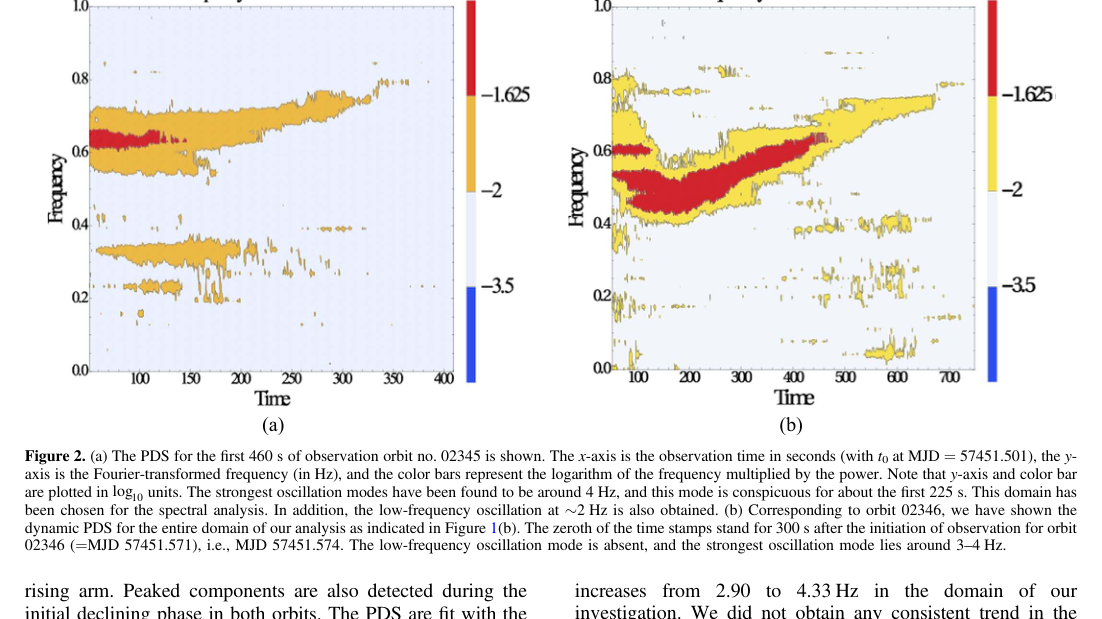
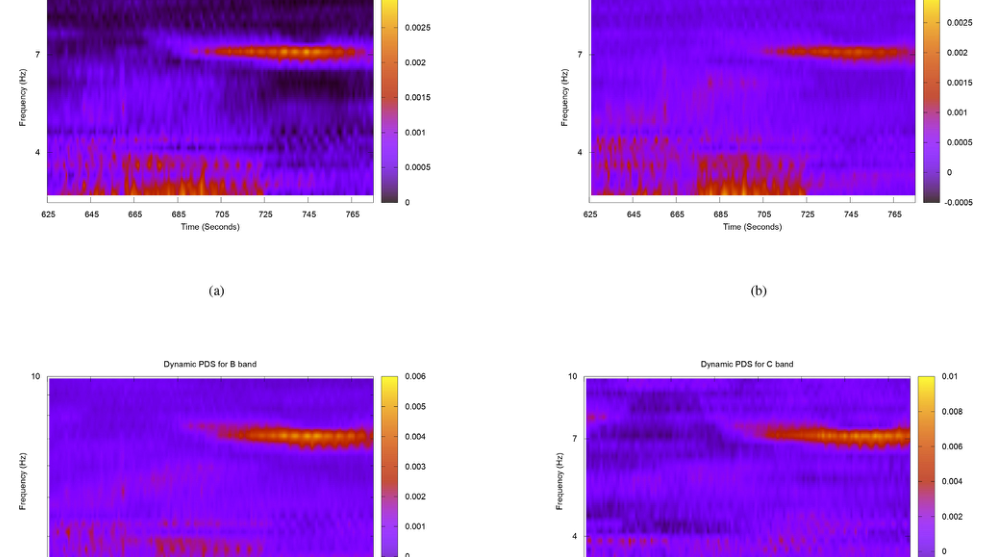
The θ-class analysis used AstroSat/LAXPC observations of U-shaped light-curve regions. Dynamic PDS showed QPO power around 4–5 Hz. Spectral fits indicated increasing Keplerian disk rate, inward shock motion, and progressive softening as the radiation intensity rose.
μ and C2 classes: comparative variability
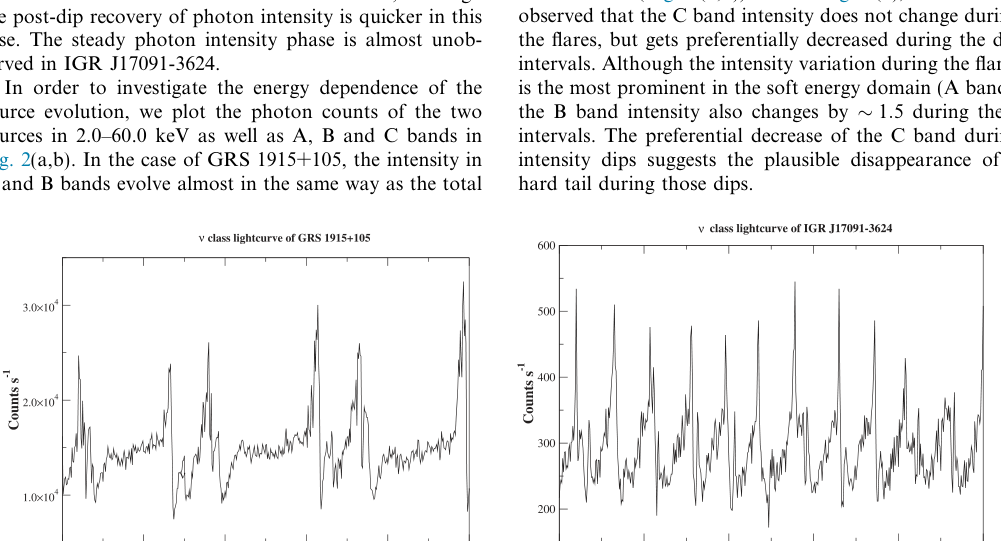
The comparative study of GRS 1915+105 and IGR J17091-3624 examined energy-resolved light curves, dynamic photon index, PDS features, and spectral fits. Similar-looking variability did not imply identical hard-band behaviour: the role of the Comptonizing/hard component differed across the two sources and classes.
Timing diagnostics
PDS, QPOs and dynamic evolution
The timing work uses power-density spectra, energy-resolved light curves, dynamic PDS maps, and QPO fitting to locate which part of the flow is participating in the observed variability. In the TCAF/POS interpretation, the shock/CENBOL region is not only the Comptonizing cloud; it can also provide the natural length scale and timescale for low-frequency oscillations.
Resources
| Topic | Resource | Notes |
|---|---|---|
| H1743-322 | MNRAS 2017 paper | RXTE/PCA, 2004 outburst, TCAF + POS. |
| Cygnus X-1 | 2019 preprint | Hard-state RXTE/PCA spectra and TCAF mass constraint. |
| GRS 1915+105 χ | RAA 2020 paper | χ subclasses, radio-loud/radio-quiet behaviour, TCAF + cutoffpl. |
| GRS 1915+105 θ | ApJ 2021 paper | AstroSat/LAXPC θ class, dynamic PDS, QPO evolution. |
| GRS 1915 / IGR J17091 | AdSR 2022 paper | Comparative spectro-temporal study of μ and C2 classes. |
| Thesis | PhD thesis | Detailed background, TCAF applications, NS/BH spectral-timing framework. |